
Branch productivity problems often look like staffing, training, or demand issues. A KPI stops improving. An audit finds inconsistent transaction handling across locations. A newly appointed manager reviews branch performance and sees that similar branches perform differently.
These signals often lead banks to review staffing models, training programs, and performance dashboards. That review matters. However, it can also miss a more practical issue closer to the teller line: the way transactions are completed across systems, screens, devices, validation checks, and exceptions.
When one transaction requires too many disconnected steps, branch productivity becomes harder to predict, manage, and improve. For Operations leaders, this matters because workflow complexity affects staffing flexibility, service consistency, branch comparability, and the true effort behind each transaction.
Recent industry research reinforces this shift in focus[1,2,3]:
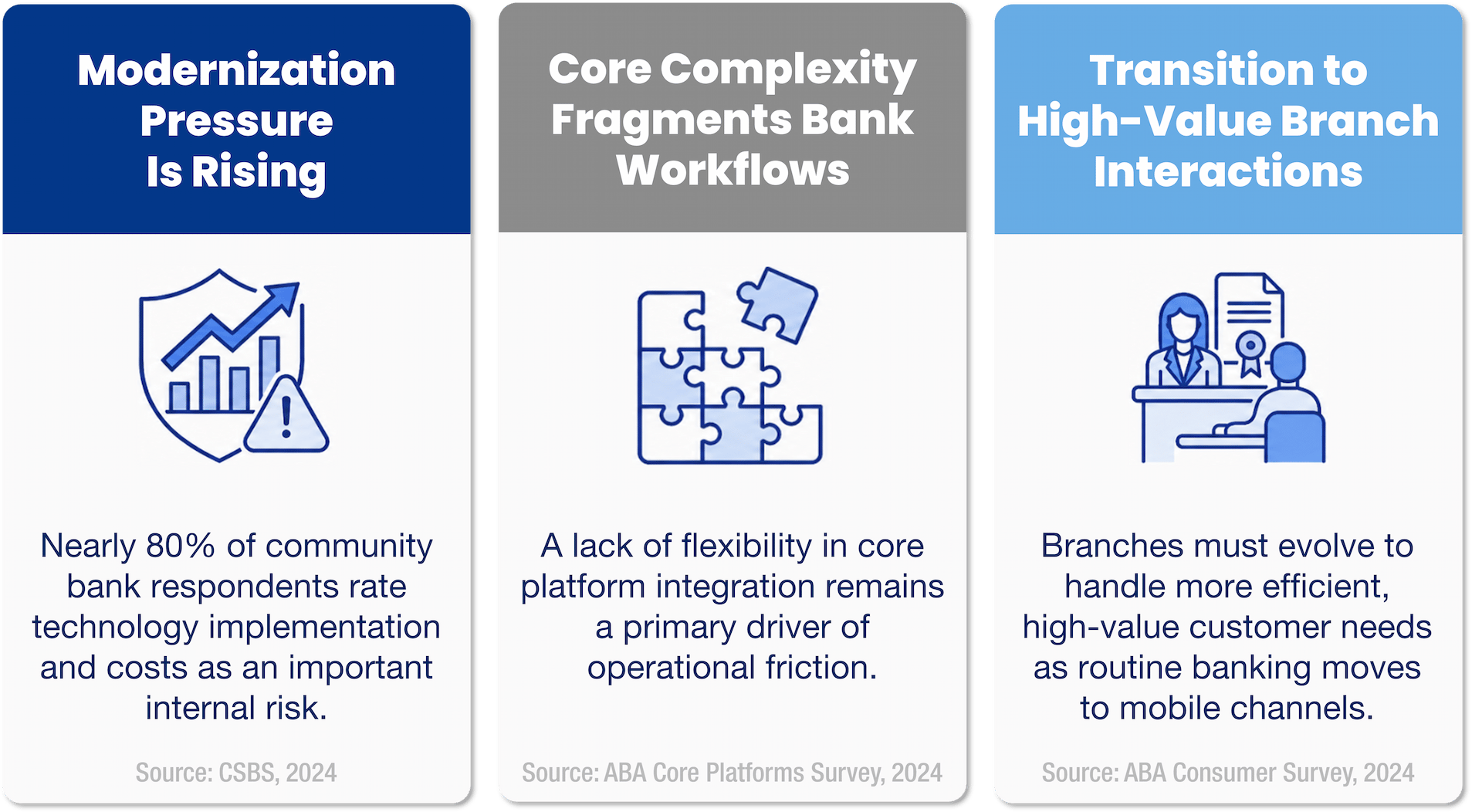
For branch operations, this creates a clear challenge. Digital channels now handle many routine interactions, while physical branch visits need to be valuable, consistent and efficient. Yet the problem is not always visible at first glance. It often sits inside the transaction itself, in the steps a teller needs to complete.
The Hidden Issue: Too Much Work Inside One Transaction
Teller workflow complexity is the amount of work required to complete one transaction across systems, screens, devices, validation checks, and exception paths. In practice, this can include:
- core banking systems,
- customer information tools,
- deposit capture screens,
- scanners, printers, and PIN pads,
- validation rules,
- manual checks,
- exception handling.
Each element may serve a purpose. The problem starts when these elements do not work together as one clear process.
Banks usually do not create this complexity in one step. It develops gradually over time. New tools are added. New Controls are put in place, etc. Each change may solve a specific problem, but the overall teller process often remains unchanged.
Over time, transactions become harder to complete consistently across branches, teams, and customer scenarios.
What This Looks Like in Daily Branch Work
Workflow complexity often appears first as inconsistency. Similar transactions may take different amounts of time depending on the systems involved, device response, validation checks, or exceptions required.
Common signs include:
- new tellers need more time to become confident,
- supervisors get pulled into routine scenarios,
- branch teams create informal workarounds,
- similar branches show different performance patterns,
- service becomes less predictable during busy periods.
This pressure can build before productivity metrics clearly decline. Transaction volumes may remain stable, while the work required to sustain branch performance increases.
One reason is the amount of switching built into everyday teller work. Each handoff between applications, devices, or validation steps forces the teller to pause, confirm context, trigger the next step, or wait for another system before moving forward.
Where Hidden Workload Builds Up
A teller transaction may appear complete when the customer leaves the counter. In reality, part of the work may continue afterward. Manual corrections, additional checks, reconciliation steps, or follow-up communication can still be needed before the transaction is fully processed.
This work is easy to underestimate because it may sit across frontline and back-office teams. Ownership becomes less clear. The true effort behind each transaction becomes harder to see. When this happens often, branch productivity can look stable on the surface while the actual amount of work continues to grow.
Why This Becomes an Operational Risk
Workflow complexity affects more than efficiency. When teller work depends on many systems, manual steps, and informal workarounds, consistency becomes harder to maintain.
This increases the risk of errors, unclear ownership, audit findings, and compliance issues.
For banks, branch efficiency depends on speed, consistency, control, and traceability. A transaction should be completed quickly, but also in a way that can be managed, reviewed, and repeated across the branch network.
Why Standard Productivity Fixes Often Fall Short
Banks often respond to productivity challenges with more training, more documentation, or another tool. These measures can help, but they do not always reduce the number of steps involved in each transaction.
Training helps employees work within the existing process. Documentation explains the process. Additional tools may solve specific problems. But if the underlying teller workflow remains complex, the daily effort remains high.
At this stage, branch productivity depends less on transaction volume or staffing levels alone. It depends more on how simple, consistent, and connected the transaction process is.
Rethinking Operational Efficiency in Branch Banking
Improving branch productivity requires banks to look at how teller transactions work from start to finish, including the steps that happen before, during, and after the customer interaction.
The practical question is simple:
How much effort does it take for a teller to complete one transaction accurately, consistently, and without unnecessary switching?
For banks and credit unions reviewing branch modernization priorities, teller workflow complexity is a practical place to start. Reducing unnecessary switching, simplifying daily work, and creating a more consistent transaction process can help branch teams use their time more effectively and give operations leaders a clearer view of how work is completed.
This is why many banks look beyond isolated teller tools and review the transaction layer that connects core systems, branch devices, workflows, and customer-facing execution.
Learn more about Axxiome’s approach to branch modernization:
https://www.axxiome.com/us/branch-modernization